
Healthcare Revenue Cycle Management (RCM)
30-Second Summary / Key Takeaways
- RCM is an unbroken financial loop: It connects clinical care to cash flow, spanning pre-registration, charge entry, coding, claim scrubbing, adjudication, payment posting, and denial management.
- The Front End controls the Back End: Over 50% of all insurance claim denials originate at the front desk (invalid insurance ID, wrong subscriber DOB, missing prior authorization).
- Top Practice Health Benchmarks: Clean Claim Rate (CCR) must be ≥ 95%; Days in Accounts Receivable (A/R) should remain under 35–40 days; Denial Rate must stay below 5%.
- Outsourcing vs In-House: High-volume practices often outsource billing to specialized third parties to maintain 98%+ collection efficiency while providers focus strictly on patient care.
🔄 1. The 7-Stage Revenue Cycle Lifecycle
Revenue Cycle Management (RCM) is the administrative and clinical financial machine that tracks patient care from appointment scheduling to the final zero-dollar account balance.
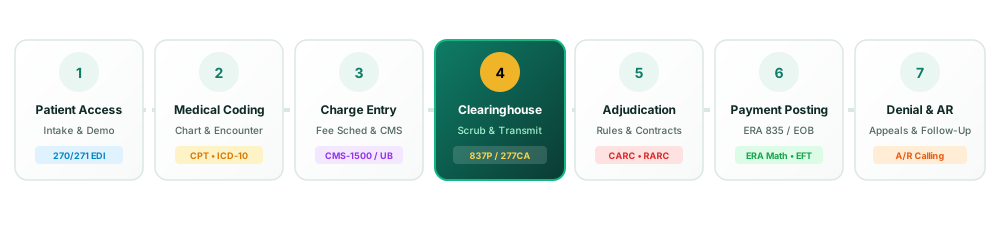
Figure 2.1: The continuous 7-stage healthcare revenue cycle. Breakdowns at stages 1 or 2 reliably create multi-week delays at stages 5 and 6.
🏥 2. The Three Operational Phases of RCM
Patient Access & Pre-Service Verification
Everything that happens before or as the patient arrives in the clinic. The front-desk receptionist and patient access team obtain demographics, scan government-issued IDs, verify real-time insurance eligibility (EDI 270/271), determine primary vs secondary coverage, calculate copays, and verify required prior authorizations.
Clinical Documentation, Charge Capture & Coding
During and immediately following the encounter, the provider documents medical necessity in the EHR. Certified medical coders and charge entry specialists translate diagnoses and procedures into HIPAA-compliant standard code sets: CPT (procedures), ICD-10-CM (diagnoses), and HCPCS Level II (supplies/drugs). Claims are scrubbed for National Correct Coding Initiative (NCCI) unbundling edits.
Claim Transmission, Adjudication, Payment Posting & Denial Appeals
Electronic 837 batches are submitted through a clearinghouse. The payer adjudicates and returns an 835 Electronic Remittance Advice (ERA) with an Electronic Funds Transfer (EFT). Payment posters reconcile payments, apply contractual write-offs (CO-45), route secondary claims, and transfer remaining deductible/coinsurance amounts to patient statements. AR callers rework denials within timely filing limits.
🧮 3. Essential RCM Financial Metrics & Live KPI Calculator
Top medical billing directors measure revenue cycle performance using two vital indicators: Days in Accounts Receivable (A/R) and Clean Claim Rate (CCR).
Days in A/R = Total Current A/R ÷ Average Daily Charges
Measures how many days on average it takes a practice to get paid for services rendered. Calculated by taking total outstanding receivables divided by (Annual Gross Charges ÷ 365).
Clean Claim Rate = (Clean Claims Paid on 1st Pass ÷ Total Claims Submitted) × 100%
The percentage of claims that pass clearinghouse and payer front-end edits on first submission without rejection, manual intervention, or denial.
Interactive Practice A/R & Clean Claim Calculator
Simulate practice cash flow and test if your Accounts Receivable is healthy.
💼 4. Worked Clinical Case: Valley Orthopedics Audit
Diagnosing a Sudden Spike in Accounts Receivable
Valley Orthopedics has 4 surgeons and generates $4,562,500 in annual charges ($12,500/day). In Q1, their Days in A/R was 36 days (Total A/R = $450,000). By Q3, their total A/R jumped to $687,500, pushing Days in A/R to 55 days. Cash flow dropped by over $230,000.
Step-by-Step RCM Audit:
- Examine AR Aging Buckets: 42% of receivables sat in the 61–90 and 91–120 day categories, indicating unpaid claims rather than unbilled charges.
- CARC Denial Code Analysis: Over 70 claims were denied under CO-27 (Expenses incurred after coverage terminated) and CO-197 (Precertification/authorization absent).
- Root Cause Discovery: Valley Orthopedics had hired two new front-desk receptionists who were not verifying insurance eligibility through the 270/271 portal and assumed patient insurance remained active from previous years.
- Remediation & Result: The clinic instituted mandatory real-time eligibility checks prior to all appointments and trained staff on pre-op authorization lead times. Within 60 days, Days in A/R dropped back to 33.4 days.
🧠 5. Retention Mnemonic & Real-World Billing Trap
PA-CR-DE-CO • The 5 Core Operations of RCM
- PA → Patient Access: Demographics, ID scan, eligibility check (270/271), copay collection.
- CR → Coding & Review: Superbill translation into CPT/ICD-10; clearinghouse scrubbing.
- DE → Delivery of 837 claim batch & ERA 835 return from payer.
- CO → Contractual Write-offs & Outstanding Balance collections (patient statements).
The "Back-End Blame Game" Fallacy
When claim volume drops or denials spike, practice owners instinctively blame the back-end billing department or payment posters.
The Reality: Industry studies confirm that over 50% of back-end claim denials are caused by errors made before the patient ever saw the doctor (incorrect member ID numbers, inverted date of birth, unverified secondary insurance, missing prior authorization). You cannot fix a broken front end with faster payment posting.
📊 6. Front-End vs Mid-Cycle vs Back-End RCM Comparison
| RCM Phase | Primary Activities | Key Roles & Tools | Primary Denial Risks If Done Wrong |
|---|---|---|---|
| 1. Front-End | Scheduling, demographic entry, insurance card scan, 270/271 eligibility verification, copay intake, prior authorization. | Front-desk receptionist, patient access specialist, EHR scheduler, clearinghouse eligibility API. | CO-27 (Coverage terminated), CO-16 (Missing subscriber info), CO-197 (Missing prior authorization). |
| 2. Mid-Cycle | Clinical documentation, encounter forms (superbills), CPT coding, ICD-10 medical necessity linking, NCCI edit checks. | Physician, nurse, Certified Professional Coder (CPC), charge entry specialist, encoder software. | CO-11 (Diagnosis not covered), CO-97 (Unbundled service bundled into primary procedure), CO-4 (Inconsistent modifier). |
| 3. Back-End | 837 claim transmission, clearinghouse error scrubbing, 835 ERA payment posting, contractual write-off, AR follow-up, denial appeals. | Medical biller, payment poster, AR collections specialist, billing manager, clearinghouse portal. | CO-29 (Timely filing expired), unworked AR resulting in bad debt write-offs, lost appeal deadlines. |
📝 7. Mid-Lesson Knowledge Checks
A high-performing multi-specialty medical clinic wants to ensure healthy cash flow. What is the target benchmark for Days in Accounts Receivable (A/R)?
Which phase of the Revenue Cycle produces more than 50% of all preventable back-end claim denials?
🃏 8. Retention Flashcards
Flip through core RCM terminology to build instant recall for billing certification exams and job interviews.
🖨️ 9. Printable Desk Cheat Sheet
Revenue Cycle Management (RCM) Desk Reference
Quick reference card for front-desk, billing, and AR follow-up teams.
The 7 RCM Milestones
1. Patient Access & Scheduling
2. Charge Capture & Encounter Review
3. Medical Coding (CPT/ICD-10/HCPCS)
4. Claim Scrubbing & 837 Submission
5. Payer Adjudication & Benefit Check
6. 835 Payment & Adjustment Posting
7. Denial Management & Patient Balance
Vital Practice Benchmarks
• Days in A/R: < 35 days (Target)
• Clean Claim Rate: ≥ 95%
• Initial Denial Rate: < 5%
• Net Collection Rate: ≥ 96%
• Bad Debt Rate: < 2% of gross charges
Top 3 Denial Prevention Rules
1. Never skip 270/271: Always run real-time eligibility prior to service.
2. Verify Prior Auth Number: Ensure auth number matches CPT exactly.
3. Monitor 999 & 277CA: Fix clearinghouse rejections within 24 hours.
🚀 10. Next Steps
Solidify your understanding of the revenue cycle by testing your knowledge or practicing in a real billing interface.
Module 2 Quiz
10 real-world exam questions on RCM benchmarks, A/R days, and denial root causes.
Take Quiz → STEP 2 • HANDS-ONeCW EHR Simulation
Explore an interactive mock eClinicalWorks practice interface to trace patient intake.
Open Simulator → STEP 3 • NEXT LESSONModule 3: The Four Ps
Understand how Patients, Providers, Payers, and Policymakers interact in US healthcare.
Start Module 3 →Module quiz
Module quiz
Frequently asked questions
What does RCM stand for in medical billing?
RCM stands for Revenue Cycle Management — the financial and administrative process that manages patient care episodes from initial appointment scheduling to final zero-dollar account balance.
What is a good benchmark for Days in Accounts Receivable (A/R)?
A healthy benchmark for medical practices is under 35 to 40 days in A/R. Anything between 35 to 45 days is average, while Days in A/R exceeding 50 days signals serious billing delays or unworked claim denials.
Why do front-desk errors cause back-end claim denials?
Because payers auto-adjudicate claims against strict policy databases. If the front desk transposes a subscriber ID, inverts a date of birth, or misses prior authorization, the payer's computer system automatically rejects or denies the claim upon arrival.